The conversation around fall protection systems often centers on the wrong thing. Fleet managers and safety directors tend to frame the decision around the upfront investment, asking whether the cost of a system can be justified in the budget. The more accurate question is what a single fall incident actually costs, and whether that figure exceeds the price of the system.
In most cases, the financial exposure from a single incident far exceeds the cost of a compliant system. Here’s why.
What a Fall Costs: The Visible Numbers
When a driver or worker falls from a flatbed trailer, the immediate financial exposure comes from several directions at once.
Workers’ compensation is typically the first and largest line item. According to National Safety Council data, the average workers’ compensation claim for a fall or slip runs $54,499. That figure covers medical treatment and a portion of lost wages, but it does not reflect the full cost to the employer.
OSHA penalties then add to the exposure. Fall protection has ranked as OSHA’s most-cited violation for 15 consecutive years, and the agency actively enforces it. A serious fall protection violation carries a maximum penalty of $16,550.
Willful or repeat violations can reach $165,514 per citation, with penalties assessed per worker and per violation, meaning a single inspection can generate fines well into six figures.
What a Fall Costs: The Numbers Below the Surface
Direct costs are only part of the picture.
OSHA’s own guidance estimates that for every dollar in direct injury costs, employers absorb one to six dollars in indirect costs. These include lost productivity from work stoppages, the time and expense of investigation and incident reporting, the cost of training a replacement worker, administrative burden, and the upward pressure on insurance premiums following a claim.
For a fall that generates $54,499 in direct workers’ comp costs, the indirect exposure, even at a conservative 2:1 ratio, brings the total economic impact closer to $160,000.
At a higher ratio, the number climbs further. And that calculation does not account for litigation, which can push total exposure well beyond what workers’ comp alone covers.
What a System Costs by Comparison
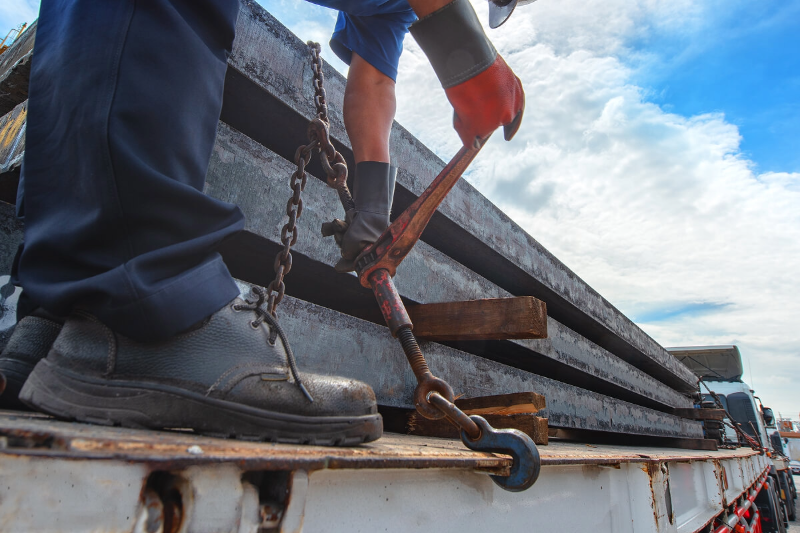
Truck Fall Prevention’s flatbed fall protection systems are priced at least 66% below competing products and are designed to install across a trailer in under 40 seconds.
For most operations, the cost of equipping a fleet with compliant, purpose-built fall protection is a fraction of the financial exposure generated by a single incident. Our systems are engineered specifically for open-deck and flatbed trailers, OSHA 1910.29-compliant, and built to withstand daily operational demands without constant maintenance.
The investment is fixed and predictable. The cost of an incident is neither.
Reframing the Decision
Fall protection is often treated as a cost center, something that draws from the budget without a measurable return on investment. That framing doesn’t hold up against the actual financial data.
When the average workers’ comp claim for a fall exceeds $54,000, when OSHA fines for willful violations can surpass $165,000, and when indirect costs reliably multiply the direct exposure, a purpose-built fall protection system is not a safety expense in the traditional sense. It’s a straightforward hedge against a quantifiable financial risk.
The question for fleet managers and safety directors isn’t whether fall protection is worth the investment; it’s whether the operation can absorb the cost of going without it.
Frequently Asked Questions About the Cost of a Flatbed Fall
How do I estimate the ROI of a fall protection system for my specific fleet?
Start with your fleet size and the average cost of a workers’ comp fall claim in your industry, then factor in your OSHA exposure based on how your loading and unloading operations are structured. OSHA provides a free Safety Pays estimator at osha.gov that calculates how much additional revenue a business must generate to offset the cost of an injury. For most fleets, a single avoided claim more than covers the cost of a full system rollout.
Will installing a fall protection system affect our insurance premiums?
Documented safety improvements can positively influence experience modification rates over time, which directly affects workers’ comp premiums. Insurers view proactive risk mitigation favorably, particularly when it involves OSHA-compliant equipment with engineering documentation. The timeline and magnitude of premium impact vary by carrier and policy structure, so it is worth raising directly with your broker.
What makes a violation “willful” in OSHA’s view, and why does the penalty difference matter?
OSHA classifies a violation as willful when an employer knew a hazardous condition existed and made no reasonable effort to eliminate it. In the context of fall protection, operating without a compliant system after being aware of the requirement, whether through a prior citation, an industry notice, or internal safety documentation, can support a willful classification. The penalty ceiling for willful violations is ten times higher than for serious violations, which is why prior knowledge of a gap makes it especially important to act on a violation and can escalate for willful or repeat offenses.
Protect Your Operation Before an Incident Costs You
Ready to protect your operation from a flatbed fall? Tell us what type of truck or trailer you use, where employees are exposed, and whether you have stake pockets, height restrictions, or limited working space. Our team will help narrow down the options.