
An Operator’s Guide to Preventing Flatbed Truck Falls With the Strap System
Falls from flatbed trucks are a major workplace hazard that can result in serious injuries or fatalities. Drivers and warehouse employees face this risk whenever they climb onto a trailer to tarp loads, secure materials, or assist with loading and unloading.
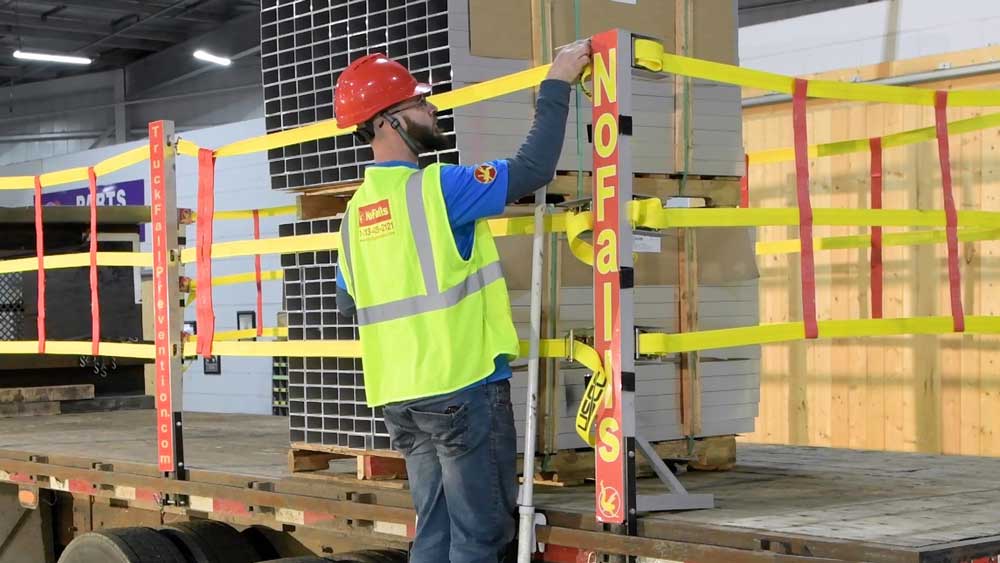
The product formerly known as the NoFalls System is now called the Strap System. This flatbed truck fall protection system creates a protective barrier around the trailer deck to help prevent workers from falling.
Using the Strap System can help protect employees, strengthen your fall prevention program, and reduce the financial and operational risks associated with flatbed truck accidents.
OSHA Regulations Pertaining to Flatbed Truck Falls
Truck drivers and warehouse employees frequently perform work at height, exposing them to serious fall hazards.
Tarping loads, securing cargo, and loading or unloading materials may require workers to walk across uneven trailer surfaces near unprotected sides and edges. Weather conditions, loose materials, and limited space can make these tasks even more dangerous.
OSHA Standards 1910.28 and 1910.29 establish requirements for protecting employees from certain fall hazards and provide criteria for fall protection systems. Employers should evaluate the hazards associated with their flatbed operations and provide appropriate protection for employees working on elevated trailer decks.
The Strap System is designed to provide OSHA- and DOT-compliant fall protection for truck drivers and other workers who perform tasks on open flatbeds, step decks, stake trucks, and compatible Conestoga trailers.
The Cost of Flatbed Truck Falls
Without appropriate fall protection, employees working on flatbed trailers face a greater risk of falling and suffering a serious or potentially fatal injury.
For employers, a flatbed fall can result in substantial medical expenses, workers’ compensation claims, third-party lawsuits, OSHA citations, and higher insurance costs. The company may also lose a valuable and experienced employee for weeks or months while that person recovers.
Workplace injuries can disrupt operations beyond the immediate incident. Other employees may need to cover the injured worker’s responsibilities, production or deliveries may be delayed, and the company may need to spend time and money hiring and training a replacement.
A serious accident can also affect employee morale. Workers are more likely to feel confident and remain productive when they know their employer has taken practical steps to protect them.
Providing the Strap System allows employers to address flatbed fall hazards before an accident occurs.
A Cost-Effective Solution for Flatbed Trailer Falls
The Strap System is a lightweight, cost-effective fall prevention system designed specifically for open flatbeds, step decks, and stake trucks.
The standard system protects both sides of a full-length 48- or 53-foot flatbed trailer. It can also be configured for shorter trailers, including 24- and 28-foot beds. Separate systems are available to protect the front and rear of the trailer, along with three-sided and four-sided configurations.
Because the Strap System can be installed from ground level, workers can put the protection in place before climbing onto the trailer. This helps reduce their exposure to unprotected sides and edges during setup.
The system is lightweight and easy to install or remove as needed. It can remain permanently installed on the trailer or be taken down in individual sections to accommodate different loading and unloading operations.
The Strap System is also compatible with Conestoga trailers and is available with inward- or outward-facing ratchets. These options allow the system to be adapted to different trailers, facilities, and operating procedures.
By helping prevent falls from trailer decks, the Strap System can reduce a company’s exposure to workers’ compensation costs, third-party liability claims, lost work time, and potential OSHA penalties.
How Does the Strap System Work?
The Strap System uses lightweight upright posts and secure straps to create a protective barrier along the exposed sides of a flatbed trailer.
The upright posts are positioned along the trailer deck and secured with quick-release pins. The straps are then extended between the posts and tightened using ratchets. Once properly installed and tensioned, the system provides fall protection around the trailer’s working area.
The system has a standard height of 52 inches above the trailer deck. The quick-release pins allow flexible spacing between the uprights, with a maximum distance of 10 feet between posts.
Sections of the Strap System can be removed or lowered when workers need access for side loading. After loading is complete, the sections can be reinstalled before employees return to the trailer deck.
The Strap System is intended to protect people working on the trailer. It does not secure freight and should not replace the cargo straps, chains, binders, or other equipment required to secure a load.
Be Proactive About Flatbed Fall Prevention
Employers should not wait for a serious accident before addressing fall hazards around flatbed trailers.
The Strap System provides a practical way to protect employees during loading, unloading, tarping, and cargo-securement operations. Its lightweight construction, ground-level installation, flexible configurations, and compatibility with multiple trailer types make it a cost-effective addition to a company’s fall prevention program.
Taking a proactive approach can help prevent injuries, reduce workers’ compensation claims, limit liability exposure, avoid potential OSHA violations, and keep employees productive.
To learn more about the Strap System and determine the right configuration for your trailers, call Truck Fall Prevention at (313) 429-2121 or submit the form below.