How a Drop-in System Made Flatbed Fall Prevention Practical in a Space-constrained Loading Operation
Industry: Steel service center and metals distribution
Application: Overhead-crane loading and unloading of flatbed trucks
Facility: Scranton-area branch with two drive-through bays and multiple loading positions
Challenge: Protecting employees on flatbeds without consuming limited warehouse floor space
“The biggest benefit is employee safety. The panels are light, easy to maneuver and simple to use.”
— Frank Mettee, Safety and Marketing Director, Pennsylvania Steel Company
Overview
Founded in 1972, Pennsylvania Steel Company is an independent, veteran-owned steel service center serving customers across the eastern United States. What began in a 2,500-square-foot warehouse with two trucks has grown into a multi-location operation supplying metals and value-added services to industries ranging from construction and manufacturing to aerospace, defense, energy and medical markets.
That growth has created a sizable and varied delivery operation. Pennsylvania Steel maintains approximately 90 vehicles, with flatbeds accounting for an estimated 75% to 80% of the fleet. At most of its facilities, employees use overhead cranes to load and unload trucks. That work requires a team member to climb onto the truck bed to connect or disconnect the crane, making falls from flatbeds one of the company’s most significant ongoing safety risks.
After a driver was injured in a fall from a flatbed, Pennsylvania Steel began evaluating stronger preventive measures. The company needed a flatbed truck fall prevention solution employees would consistently use and one that could function within the real space and workflow constraints of its Scranton-area operation.
The Challenge
Pennsylvania Steel had already taken steps to reduce the potential severity of a fall, including adopting Type II safety helmets with chin straps for drivers and employees involved in loading and unloading. However, helmets could not prevent a worker from falling in the first place. The company wanted an engineering control that would create a physical barrier around the elevated work area.
Mobile rolling barricades worked in facilities with enough open floor space, but they were not a practical match for the Scranton-area branch. The facility has two drive-through loading bays, limited aisle clearance and trucks that can move through nine or more loading positions during a single loading cycle. Protecting every position with rolling units could have required dozens of panels while creating additional storage, maneuvering and caster-maintenance demands.
Pennsylvania Steel needed a system that could:
- Stay with the truck as it moved through the facility instead of occupying valuable floor space
- Fit a mixed fleet with differences in trailer brands, stake-pocket spacing and pocket condition
- Be light and simple enough for employees to install without resisting or bypassing the process
- Add fall prevention without materially slowing a loading cycle that can already take up to two hours
Earlier on-truck approaches did not fully meet those requirements. A strap-based system proved too time-consuming for the application. Initial drop-in panels also revealed a fit issue: variations among trailers sometimes prevented both ends from seating snugly in the stake pockets, which allowed the panel to move. Pennsylvania Steel needed a more adaptable design.
The Solution
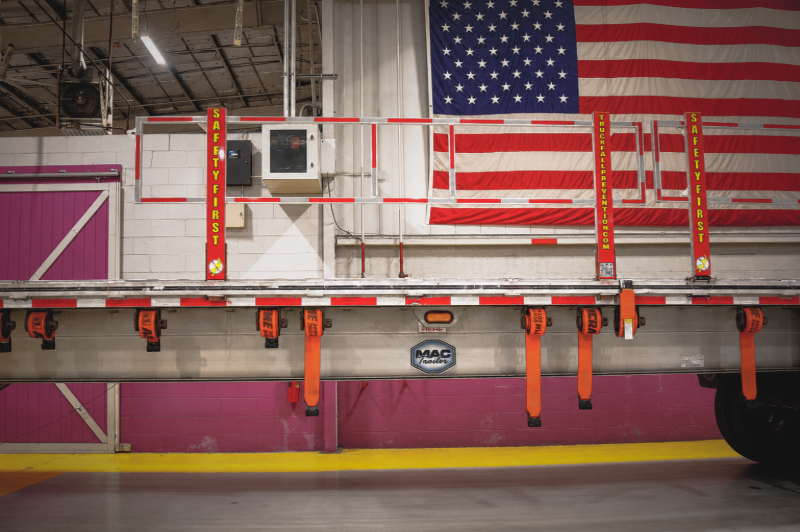
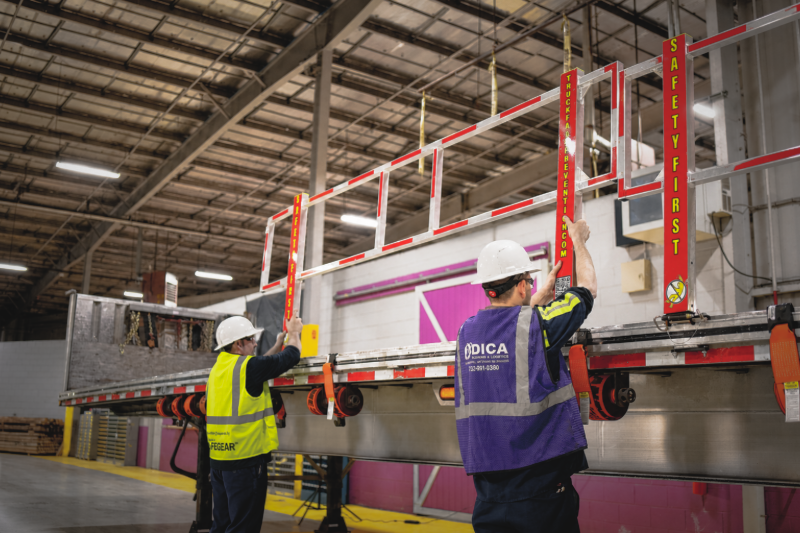
Truck Fall Prevention worked directly with Pennsylvania Steel to refine the Drop-In System for the company’s mixed fleet. After Frank Mettee shared feedback about inconsistent stake-pocket spacing, Truck Fall Prevention developed a panel with a floating hook on one side. The adjustment allows the panel to accommodate dimensional differences and fit securely across a wider range of trucks and trailers. A redesigned demo unit arrived for evaluation within approximately two weeks.
The customized Drop-In System gave Pennsylvania Steel the on-truck protection its operating environment required:
- Lightweight aluminum panels that employees can lift and maneuver easily
- A floating-hook design that improves fit across varying stake-pocket configurations
- A system that travels with the truck from one loading position to the next
- Fast installation that creates a guardrail-style barrier around the work area
- Continued product refinement, including a planned method for tethering the locking pins to the panels so components are less likely to be misplaced
Pennsylvania Steel initially ordered two panels for a controlled trial. After testing the updated design across incoming trucks, the company moved forward with four additional panels, bringing the planned total to six and providing enough equipment to protect one full truck bed at a time.
The Impact
Although the updated system was still in the early stages of deployment at the time of the interview, the initial operational and employee feedback was strongly positive. The floating-hook design removed much of the trial and error associated with matching panels to different trailers. Employees described the panels as light, easy to lift and easy to maneuver.
Just as important, the system has been practical enough to support consistent use. Mettee estimates that installing the panels adds only about three to four minutes to a truck-loading process that can take up to two hours. Once employees saw how simple the system was to install, they were more inclined to use it without negative feedback.
The early impact includes:
- A preventive barrier designed around the facility’s actual truck movement and space constraints
- Greater fit flexibility across Pennsylvania Steel’s mixed flatbed fleet
- Minimal disruption to loading productivity
- Positive acceptance from the supervisors and employees involved in the trial
- A visible demonstration that the company is investing in employees’ safety and testing new ideas to reduce fall exposure
Pennsylvania Steel plans to continue evaluating the system as the additional panels enter service and to collect longer-term performance data. For now, the strongest early result is straightforward: the company has found a practical fall prevention approach employees can use within an operation where floor space and truck movement made conventional rolling protection difficult.
Testimonial
“The biggest benefit is employee safety. The panels are light, easy to maneuver and lift. Once employees see how simple the system is, it shows them that we care about their safety. Truck Fall Prevention listened to our feedback, developed the floating-hook solution almost immediately and had a new demo unit to us within two weeks. The experience has been great.”
— Frank Mettee, Safety and Marketing Director, Pennsylvania Steel Company
Build Fall Prevention Around Your Operation
Every loading environment presents different challenges, from limited aisle space and mixed trailer fleets to multiple loading positions and demanding production schedules. Truck Fall Prevention develops Mobile, On-Truck and Custom Systems that help protect employees without creating unnecessary obstacles for the operation.
Request a quote to discuss a fall prevention solution built around your trucks, facility and workflow.